


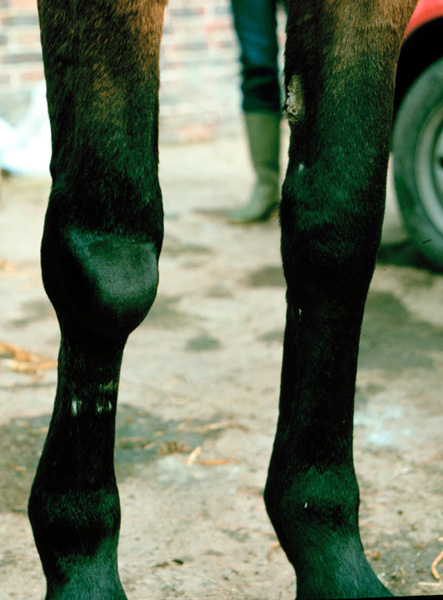
A swollen knee with no lameness often indicates a carpal hygroma in a horse. This condition is a fluid-filled swelling on the front of the carpal joint. It typically results from direct, repeated trauma, such as hitting the knee when lying down. The swelling is often cosmetic, but a veterinary diagnosis is essential.
It’s a common and understandably perplexing scenario for horse owners: you go to the paddock or stable and find your horse with a puffy, swollen knee, yet he appears completely comfortable and is moving soundly. This presentation, a significant swelling of the carpus (the horse’s knee) without concurrent lameness, is a classic clinical puzzle. While alarming to see, the absence of pain is a critical clue that helps guide a proper diagnosis.
Let’s explore the conditions a veterinarian considers in this situation, moving from the most common and benign to the more serious underlying issues that require immediate attention.
The Clinical Picture: What the Signs Suggest
When a horse presents with joint swelling but no lameness, it suggests the source of the swelling is not causing significant pain during movement. This often points to an issue that is either superficial (outside the joint) or is in a very early, non-painful stage. However, any swelling is a sign of inflammation or trauma, and it should never be dismissed.
I am often reminded of a case with a lovely performance mare whose owner was alarmed to find a soft, prominent swelling on the front of the knee one morning. The mare, however, was trotting happily in her paddock. Her soundness was a key piece of information that steered the diagnostic process. This is precisely why a systematic evaluation is important, to differentiate a simple cosmetic blemish from a subtle but significant injury.
Differential Diagnoses: The List of Possibilities
When faced with a swollen carpus and a sound horse, a veterinarian will work through a list of potential causes, known as differential diagnoses.
1. The Most Common Culprit: Carpal Hygroma
This is typically the first condition to rule in or out. A carpal hygroma is a fluid-filled sac (a false bursa) that forms under the skin on the front of the knee. Critically, it is not connected to the joint capsule itself.
- Mechanism: It arises from repeated, low-grade trauma, most often from the horse repeatedly knocking its knee when rising or lying on hard ground or inadequate bedding. The body forms this fluid pocket as a protective cushion.
- Key Signs: A well-defined, soft, and often fluctuant (squishy) swelling. It is typically cool to the touch and non-painful on palpation.
- Why No Lameness? Because the swelling is superficial and separate from the moving parts of the joint, it doesn’t cause pain during flexion or weight-bearing.
2. Synovial Effusion (“Windpuffs”) & Minor Contusions
If the swelling is more generalized around the joint rather than a distinct pocket, we consider synovial effusion. This is an accumulation of excess fluid inside the joint capsule.
- Mechanism: It can be a response to minor trauma like a twist or knock, a period of strenuous work, or it can be the very first subtle sign of early-stage arthritis. A simple contusion (bruise) from a kick or impact can also cause localized, firm swelling that may not be severe enough to induce lameness.
- Key Signs: A more diffuse puffiness that obscures the normal contours of the joint. It may feel slightly warm, but often is not.
- Significance: While sometimes transient, persistent effusion is a red flag that the joint environment is abnormal and requires further investigation.
3. Deeper, Underlying Conditions: OA and OCD
This is where the situation demands more caution. Chronic, low-grade swelling can be the silent harbinger of progressive disease.
- Early Osteoarthritis (OA): In its initial stages, the breakdown of cartilage can trigger mild inflammation and swelling long before the horse experiences pain or lameness. That puffiness is the body’s first response.
- Osteochondritis Dissecans (OCD): This is a primary concern in young horses (generally under three). OCD is a developmental orthopedic disease where a fragment of cartilage and/or bone fails to attach properly, leaving it loose within the joint. Often, the only outward sign is persistent joint effusion.
4. The Hidden Threat: Non-Displaced and Chip Fractures
The most compelling reason for a veterinary exam is to rule out a fracture. It is entirely possible for a horse to have a fracture in the carpus and show no lameness initially.
- Chip Fractures: Common in athletic horses, a small chip can break from the edge of a carpal bone during hyperextension. At first, the only sign may be sudden joint swelling as the body responds to the trauma. The horse may remain sound until the fragment begins to cause irritation.
- Stress Fractures: Repetitive concussive force can cause microfractures in the carpal bones. These are insidious injuries that may only present as chronic, low-grade puffiness.
- Splint Bone Fractures: The proximal (top) end of the splint bones articulates near the carpus. A stable, non-displaced fracture in this location can cause swelling on the side of the leg without producing lameness.
The Diagnostic Process: How We Find the Answer
A definitive diagnosis is key to appropriate treatment. The process involves:
- Thorough Physical & Lameness Exam: Even if the horse appears sound, a veterinarian will watch it move on different surfaces and perform flexion tests. This is followed by careful palpation of the knee to assess for heat, pain, and the specific location and texture of the swelling.
- Diagnostic Imaging:
- Radiographs (X-rays): Essential for visualizing bone. Multiple views are required to screen for fractures, bone chips, or arthritic changes.
- Ultrasound: The gold standard for evaluating soft tissues. Ultrasound is invaluable for differentiating a hygroma from joint effusion, as well as for examining the health of surrounding ligaments and tendons.
Treatment and Management: The Path Forward
The treatment plan is dictated entirely by the diagnosis.
- For Hygromas & Contusions: Management is typically conservative and focused on eliminating the cause. This includes deepening bedding, rest, and a course of cold therapy (icing/cold hosing) to reduce inflammation.
- For Chip Fractures or OCD: Arthroscopic surgery is the modern standard of care. This minimally invasive procedure allows for the removal of the bone or cartilage fragment, providing the best chance for a full return to function.
- For Early Arthritis/Effusion: Management may involve intra-articular medications (joint injections), tailored exercise programs, and systemic therapies to support long-term joint health.
- Red Light Therapy: Red light therapy can be a valuable non-invasive treatment option, as it uses specific wavelengths of light to penetrate the tissue and stimulate cellular energy, which helps reduce inflammation and improve local circulation. This therapeutic effect can aid in resolving the fluid associated with conditions like hygromas and contusions and support the body’s natural healing process for underlying strains or micro-trauma.
The Owner’s Role: A Partnership in Care
Your role in this process is vital. As the horse’s daily caregiver, your observations and diligence are invaluable. Adhering to the prescribed treatment plan, whether it’s rest, therapy, or rehabilitation, is paramount. Monitor the swelling daily and communicate any changes to your veterinarian. Patience is essential, as allowing adequate time for healing is the best way to prevent re-injury.
Ultimately, a swollen knee without lameness should be viewed as a clear signal from the horse that something is amiss. A prompt and thorough veterinary evaluation is the only way to uncover the true cause and ensure you are providing the right care, protecting your horse’s long-term health and soundness.
Common Questions
See common questions below.
If there’s no fracture and no lameness, how does a vet even know how bad it is?
Well, that’s the thing, you know? They get their hands on it. They’re feeling for heat, how firm it is, exactly which part of the knee is puffy. The cause is the biggest clue. A hygroma from lying on a hard floor is a different level of ‘bad’ than a puffy joint from early arthritis. The horse’s response to some simple management, like cold hosing, also tells them a lot about what’s really going on inside.
What’s the usual treatment for just a puffy knee with no other signs?
It really, really depends on the diagnosis. But for a lot of these mysterious cases, it might just be… watching it. Your vet will probably say to try cold therapy or a wrap first. See if that helps. If the horse responds well and the swelling goes down, then you’ve learned something. If it doesn’t, or comes right back, then you know you need to dig deeper to find the real cause. It’s a step-by-step process.
But could it still be a small fracture even if he’s not limping?
Yes. Absolutely, one hundred percent, yes. That’s the scary part and why you can’t just guess. Some hairline fractures or chips in just the right (or wrong) spot won’t cause lameness at first. A vet needs to do a proper exam, and usually get x-rays, to officially rule that out. It’s the only way to know the true cause for sure and make sure you’re treating the right problem. You don’t want to be riding a horse with a fracture you didn’t know was there.


